
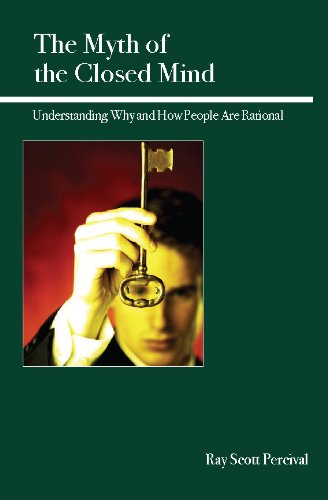
The Myth of the Closed Mind: Understanding Why and How People Are Rational
Product details
| Management number | 231627754 | Release Date | 2026/06/18 | List Price | US$15.78 | Model Number | 231627754 | ||
|---|---|---|---|---|---|---|---|---|---|
| Category | |||||||||
In a time when many people are cynical about truth and rational argument, Ray Scott Percival topples erroneous presuppositions behind notions such as a "Post-Truth" society. The Myth of the Closed Mind is a deep weapons-grade assault on the ubiquitous idea that we are impotent when it comes to defending the role of critical debate in civilised society against, for example, the anti-intellectual cajoling and goadings of "Political Correctness" and "Identity Politics". The Myth of the Closed Mind is not just a tool-kit for use in argumentation. But anyone who reads it will be able to design better rhetorical containers for their logical cases. You will see that logic and rhetoric are compatible, just as Socrates maintained. A truth cherished in a poem is still a truth. Rather, the book is an explanation why those who still believe in free speech and logical argument can feel confident that truth and logic enhance persuasion precisely because they are sound. "It's like talking to a brick wall" and "We'll have to agree to disagree" are popular sayings referring to the frustrating experience of discussing issues with people who seem to be beyond the reach of argument. It's often claimed that some people--fundamentalists or fanatics--are indeed sealed off from rational criticism. And every month new pop psychology books appear, describing the dumb ways ordinary people make decisions, as revealed by psychological experiments. The conclusion is that all or most people are fundamentally irrational. Ray Scott Percival sets out to demolish the whole notion of the closed mind and of human irrationality. There is a difference between making mistakes and being irrational. Though humans are prone to mistakes, they remain rational. In fact, making mistakes is a sign of rationality: a totally non-rational entity could not make a mistake. Rationality does not mean absence of error; it means the possibility of correcting error in the light of criticism. In this sense, all human beliefs are rational: they are all vulnerable to being abandoned when shown to be faulty. Read more
| ASIN | B007ED2YOG |
|---|---|
| XRay | Not Enabled |
| ISBN13 | 978-0812697957 |
| Language | English |
| File size | 593 KB |
| Page Flip | Enabled |
| Publisher | Open Court |
| Word Wise | Enabled |
| Print length | 323 pages |
| Accessibility | Learn more |
| Screen Reader | Supported |
| Publication date | December 15, 2011 |
| Enhanced typesetting | Enabled |
Bestseller ranking
Criticism


Customers who viewed this product also viewed
Spray Repellents



Correction of product information
If you notice any omissions or errors in the product information on this page, please use the correction request form below.
Correction Request Form